
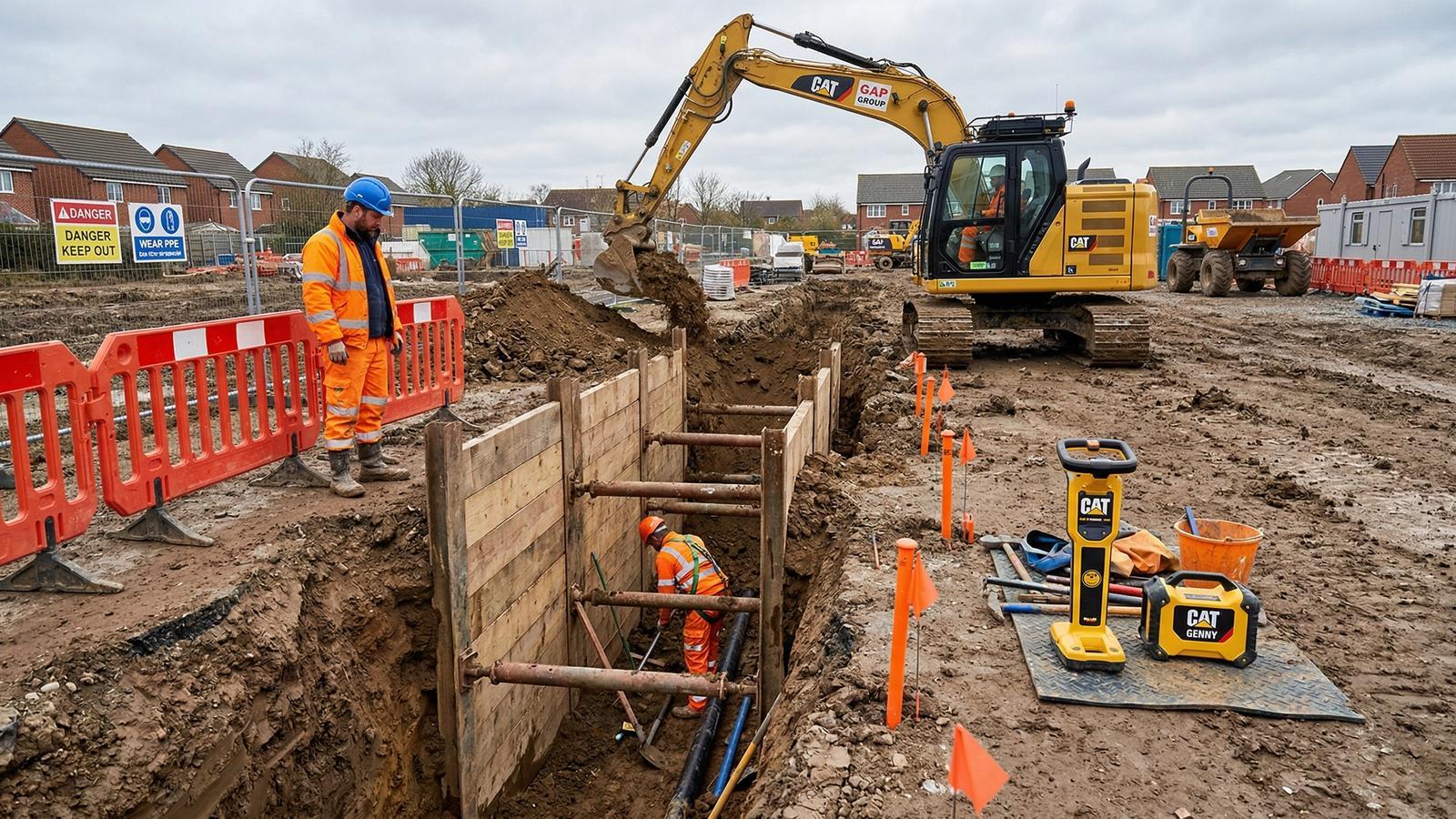
Learning how to excavate a construction site starts long before an excavator reaches the ground. Successful earthwork depends on drawings, permits, underground utility information, soil conditions, access planning, drainage, equipment selection, and a safe work method. Excavation can create serious hazards, especially where workers enter trenches or operate near existing buildings and buried services.
1. Review Plans, Scope and Site Conditions
Begin with the approved construction drawings, geotechnical information, survey, and project specifications. Establish the excavation limits, formation levels, slopes, foundation locations, trench routes, and required tolerances. Confirm whether the work involves bulk earthmoving, foundations, basements, utility trenches, or a combination.
Walk the site to identify access constraints, overhead power lines, nearby structures, traffic, water sources, trees, retaining walls, and neighboring property. A geotechnical engineer or other qualified professional may be needed to assess soil and groundwater conditions.
2. Obtain Permits and Locate Underground Utilities
Check local building, right-of-way, environmental, stormwater, and excavation permit requirements before work begins. Contact the relevant utility-locating service and utility owners to identify electric, gas, water, sewer, communications, and other buried infrastructure. Marked lines do not remove the need for safe digging practices and required verification around sensitive utilities.
3. Prepare the Site
Set up fencing, signs, traffic controls, safe access routes, erosion and sediment controls, and designated equipment areas. Remove vegetation or surface obstructions only as authorized. Establish survey control and benchmarks so the excavation depth and position can be checked accurately.
4. Select the Right Excavation Equipment
Equipment selection depends on material, volume, depth, reach, site access, and haul distance. Common equipment includes excavators, backhoe loaders, bulldozers, wheel loaders, skid steers, dump trucks, graders, and compactors. A small urban site may need compact equipment and careful spoil removal, while a large development may require a coordinated fleet.
Confirm operators are trained and authorized. Plan reversing, loading, and vehicle-pedestrian separation. Inspect machines before use and keep workers out of swing-radius and blind-spot areas.
5. Excavate in Controlled Stages
Strip topsoil and keep it separate if it will be reused for landscaping. Excavate in layers or stages to the planned formation. Maintain control of grades and avoid over-excavation; if the formation is disturbed or excavated below design level, follow the engineer’s approved remediation method instead of casually backfilling with loose soil.
Manage water as work proceeds. Surface runoff should be diverted where practical, and groundwater or seepage may require engineered dewatering. Discharged water must follow project and environmental requirements.
6. Manage Spoil, Haulage and Material Reuse
Classify excavated material according to project specifications and applicable environmental rules. Separate reusable soil, unsuitable material, and potentially contaminated material. Keep stockpiles stable and away from excavation edges as required by the site safety plan. Plan truck routes, loading areas, wheel cleaning, and legal disposal or reuse locations.
7. Protect Workers in Trenches and Excavations
Never assume soil is stable. OSHA requires protective systems for trenches 5 feet (1.5 m) deep or greater unless the excavation is entirely in stable rock; a competent person may determine that a protective system is unnecessary for a trench less than 5 feet deep where there is no indication of a potential cave-in. At 20 feet or deeper, the protective system must be designed by a registered professional engineer or based on appropriate engineer-prepared or approved tabulated data.
Protective systems may include sloping, benching, shoring, or shielding, depending on the soil and site. OSHA also addresses safe access and egress, water accumulation, adjacent structures, spoil placement, and inspections. Review the official OSHA trenching and excavation guidance and applicable 29 CFR 1926 Subpart P requirements. This summary is not a substitute for a competent person’s inspection or a project-specific safety plan.
8. Inspect, Verify and Prepare for the Next Trade
Check line, level, dimensions, bearing conditions, and formation against the drawings. A competent person should inspect excavations as required and after events that could increase hazards, such as rain or changing ground conditions. Keep records of inspections and hold points. Obtain engineer or inspector approval where required before placing blinding concrete, foundations, pipes, or backfill.
Common Excavation Mistakes to Avoid
- Starting before utility locations and permit requirements are confirmed.
- Allowing workers into an unprotected trench.
- Stockpiling soil or parking heavy equipment too close to an edge.
- Ignoring surface water, groundwater, or weather changes.
- Mixing topsoil, reusable fill, and waste material.
- Skipping survey checks and excavating below the required formation.
Frequently Asked Questions
What is the first step in site excavation?
Review approved plans, survey and soil information, permissions, and underground utility locations before mobilizing equipment.
When does a trench need a protective system?
OSHA generally requires one at 5 feet deep or more, with a limited exception for stable rock and a competent-person determination for certain shallower trenches.
Who should inspect an excavation?
A competent person with the knowledge and authority to identify hazards and take corrective action must perform inspections as required by OSHA and the site safety plan.
Conclusion
Safe site excavation is a controlled process: investigate, permit, locate utilities, prepare access, choose equipment, excavate in stages, manage water and spoil, protect workers, and verify the finished formation. Follow project engineering requirements and OSHA rules at every stage. Safety planning is part of the excavation method, not an extra step after digging begins.

Lily Rose is a passionate food blogger with years of experience exploring menus, flavors, and dining trends, delivering clear, reliable insights that help readers discover great food and make confident choices.